Mechanism
How Lymph Savior™ works
Lymph Savior works, to the extent it works at all, through three plausible mechanisms: venous tone from horse chestnut, capillary filtration from gotu kola, and mild diuresis from cleavers and burdock. It does not “drain lymph” — lymph has no pump, and flow depends on muscle contraction, breathing and vessel-wall contraction, none of which a capsule can apply.
Key takeaways
- Steps one and two of the vendor diagram are ordinary absorption, nothing more.
- Horse chestnut acts on venous tone; gotu kola on capillary filtration.
- Lymph moves by muscle, breath and vessel contraction — all mechanical.
- Expect eight to twelve weeks, judged on a measurement, not a feeling.
The vendor’s four steps, read critically
The official graphic describes four stages: take daily, nourish and absorb, support and detox, feel the difference. Steps one and two are uncontroversial — you swallow two capsules with a meal and the contents are absorbed in the small intestine like any oral botanical. There is no delivery technology.
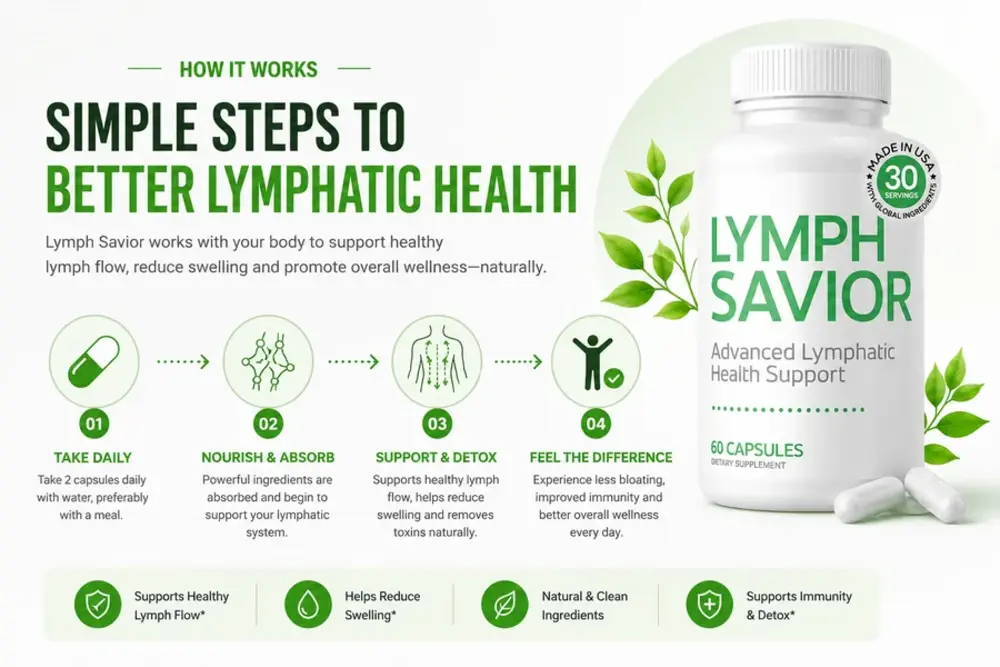
Step three is the problem. “Support and detox” is marketing language, not a demonstrated mechanism. Nothing on the ingredient list is a tissue-specific carrier; once absorbed, the compounds circulate systemically like any other herbal constituent.
Why lymph cannot be pushed by a capsule
Your circulatory system has a heart. Your lymphatic system does not. Lymph moves because skeletal muscle squeezes the vessels, because breathing changes thoracic pressure, and because the vessels contract slowly in waves. One-way valves stop it falling back. All three forces are mechanical.
That is why the interventions with the strongest evidence for lymph flow are physical — walking, calf pumps, elevation, diaphragmatic breathing, compression garments and manual lymphatic drainage. A capsule applies none of them. Full explanation in your lymph system has no pump.
If a product claims to drain your lymph, ask what force it is applying. There is not one. The honest version is that certain plants may support fluid balance, vessel tone and capillary integrity — useful, and considerably less dramatic.
The three mechanisms that are plausible
1. Venous tone — horse chestnut 🦵
Aescin, the active saponin complex in horse chestnut seed extract, has been studied in chronic venous insufficiency with reported reductions in leg volume, ankle and calf circumference, and the heavy-leg sensation. Trial dosing is typically 300 mg of standardised extract twice daily, delivering around 50 mg aescin per dose. See our horse chestnut dose guide.
2. Capillary filtration — gotu kola 🩸
Titrated extract of Centella asiatica has been studied in venous insufficiency and microangiopathy, with reported effects on capillary filtration rate, ankle oedema and the integrity of the vessel wall’s connective tissue. Trial doses sit around 60–120 mg of standardised triterpenes daily.
Horse chestnut works mainly on venous tone; gotu kola works mainly on the capillary wall. In principle they complement each other, which is the most defensible argument for this formula as a formula. In practice neither amount is disclosed.
3. Mild diuresis — cleavers and burdock 💧
Both are traditional gentle diuretics with some supporting lab work. If your puffiness is partly fluid retention from salt, heat or long hours on your feet, a mild diuretic effect is a believable small contribution. Tell your doctor if you already take a prescribed diuretic.
What is not happening
- No toxin removal. Lymph nodes filter pathogens and cell debris; your liver and kidneys handle metabolic clearance.
- No “unblocking” of nodes. Nodes are immune organs, not drains, and they do not clog. See why lymph nodes do not clog.
- No fat loss. Any early weight change on a mild diuretic is water.
- No treatment of lymphedema. That is a medical condition with a specialist pathway. ⚠️
🚑 When swelling needs a doctor, not a supplement
- Sudden swelling, or swelling in one leg only — especially with calf pain, warmth or redness. That pattern can indicate a clot and needs same-day assessment.
- Swelling with breathlessness, chest discomfort or rapid weight gain over a few days.
- Skin that is breaking down, weeping or ulcerated.
- Persistent swelling in both legs that does not settle overnight — this deserves a proper work-up for heart, kidney, liver, thyroid and medication causes first.
Lymph Savior is a dietary supplement, not a treatment for lymphedema, venous disease, heart failure or kidney disease. More in our guide to when swelling needs a doctor.
How to test it properly on yourself 📏
- Take two capsules at the same time each morning, with food. Morning because of the yerba mate caffeine.
- Measure one thing: ankle circumference at a fixed point, at the same time each evening, once a week. Write it down.
- Change nothing else for the first month. Starting compression, a walking routine and a supplement in the same week teaches you nothing.
- Review at eight weeks against your log. If the numbers have not moved, you still have four months of refund window. 🔁
Our guide on how long Lymph Savior takes to work covers the realistic timeline in more detail.
Frequently asked questions
Eight to twelve weeks of consistent daily use is a fair trial for a botanical blend. Anything claimed in days is water weight or expectation.
Yes, and that combination makes more sense than either alone. Compression has far stronger evidence than any oral botanical for leg swelling.
Possibly, mildly. Cleavers and burdock are traditional gentle diuretics. Tell your doctor if you already take a prescribed diuretic.
Sources & further reading
Check the current price yourself 🌿
Lymph Savior is sold through one official checkout. Promotions change without notice, so confirm the price and guarantee terms on the vendor’s page before you pay. If you take any prescription, speak to a pharmacist first.
Check Today’s Price180-day money-back guarantee · 60 capsules per bottle · not evaluated by the FDA · not a treatment for any disease